Living matter · machines · scales
What Is Life?
Living matter is built by machines that make other machines.
The distinctive feature of living matter is not its material. The same atoms occur outside life. What differs is the organization of processes that continually rebuild the system: proteins are synthesized, membranes renewed, gradients restored, DNA copied, damage repaired, and eventually a new cell assembled.
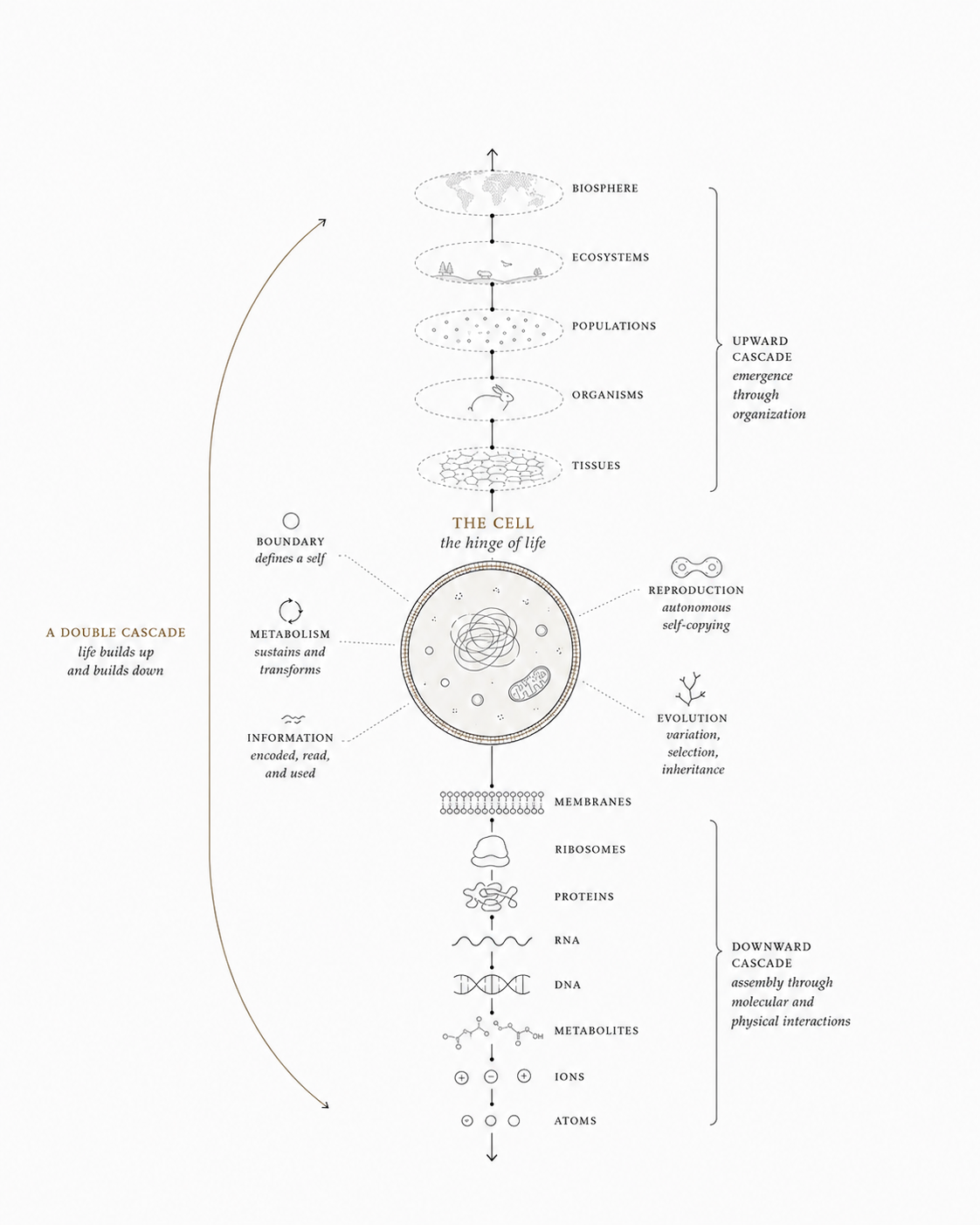
The double cascade
The cell lies between two cascades of organization. Below it are membranes, ribosomes, proteins, nucleic acids, metabolites, ions, and atoms. Above it are tissues, organisms, populations, ecosystems, and the biosphere.
The important relation between these scales is constructive. Molecular machines build and maintain cells. Cells build tissues and organisms. Organisms in turn change the environments in which cells and organisms survive. Construction therefore runs through the hierarchy in both directions.
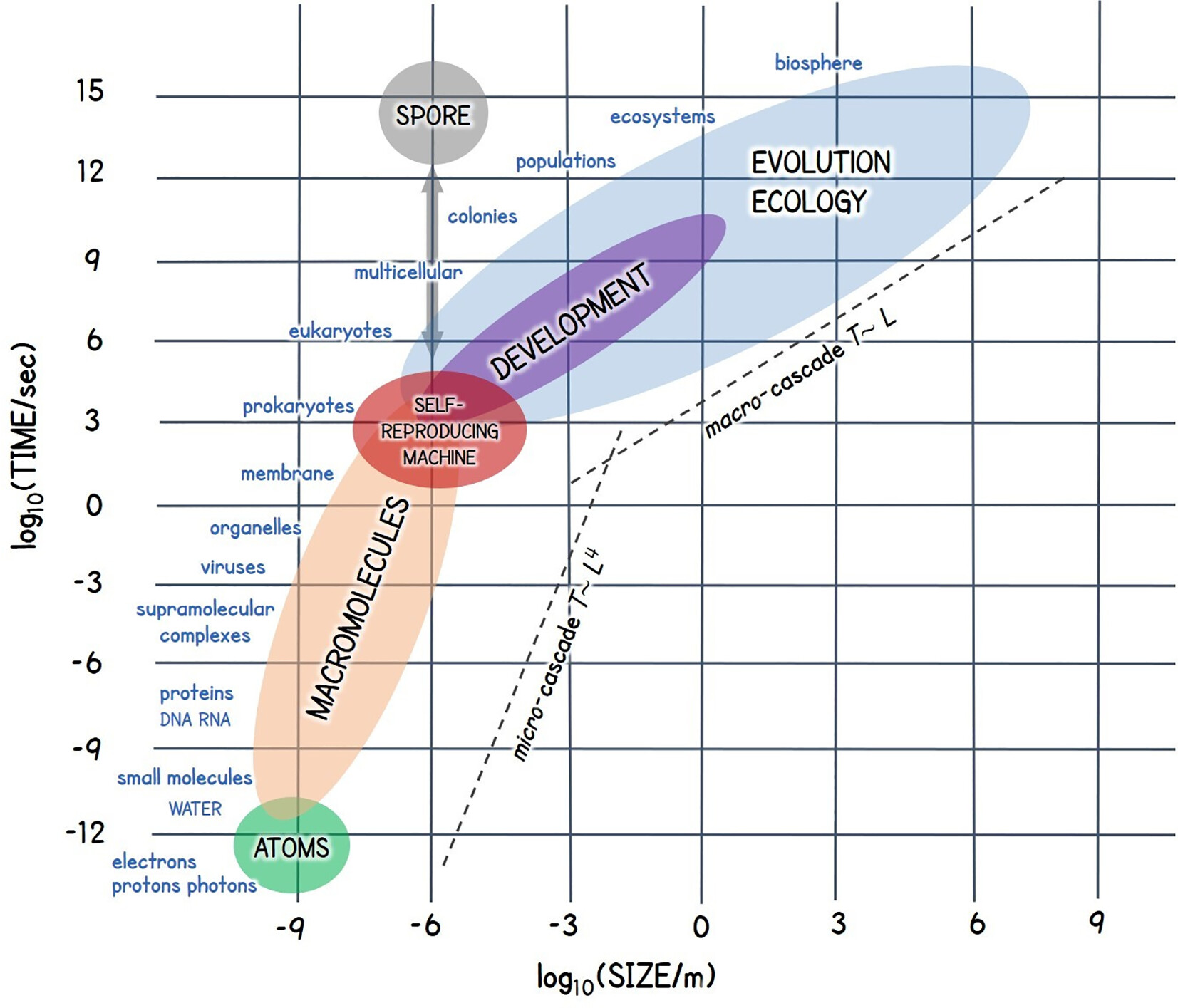
The cell
The cell is the smallest known system that contains enough machinery to reproduce its own organization autonomously. A protein can perform work, but it cannot make the system that makes proteins. A virus carries genetic information, but depends on a host for translation, metabolism, and much of its assembly. A cell contains both the description and much of the machinery needed to act on it.
This is why the cellular scale is special in the cascade. Molecular processes that are individually local become, together, a system able to construct another functioning system of the same kind.
Boundary
A cell also maintains an inside distinct from the outside. The membrane is thin, permeable, and active. Channels, pumps, transporters, and receptors regulate fluxes of ions, nutrients, waste, and signals.
The cell is therefore neither closed nor simply open. It maintains a difference from its surroundings by controlling exchange with them.
Reproduction
Reproduction is more than copying DNA. Membranes, ribosomes, enzymes, metabolites, and regulatory machinery must also be produced in the right proportions and assembled into a working cell. The genome is copied as a sequence; the cell is reconstructed as matter.
Information and machinery
DNA has biological meaning because molecular machines can read it. Ribosomes translate RNA; polymerases copy nucleic acids; regulatory proteins control when sequences are used. The dependence also runs in the opposite direction: those machines are themselves produced from genetic descriptions.
Description and construction are therefore coupled. Neither the information alone nor the machinery alone constitutes a living system.
Water
Cellular machinery works in salty water. Protein surfaces organize hydration layers; membranes create aqueous interfaces; ions screen charge; water carries heat, momentum, polarization, and chemical flux. Near biological surfaces its structure and dynamics can differ from those of bulk water.
How much of this interfacial response is merely local solvent physics, and how much contributes directly to molecular coupling, remains open. Interfacial water is one place where the cascade meets the surrounding medium.
Evolution
Reproduction transmits organization; variation changes it. Selection acts on those changes. Over time, new proteins, regulatory circuits, metabolic pathways, boundaries, and forms of cooperation appear.
A new machine can also create conditions in which further machines become useful. Evolution therefore changes not only living structures, but the set of constructions available to later evolution.
A working definition
This definition emphasizes construction. Metabolism supplies matter and energy; information helps specify the machinery; the boundary maintains the system; reproduction rebuilds it; evolution changes it.
Further
- Tlusty T & Libchaber A — Life sets off a cascade of machines · Proc Natl Acad Sci USA (2025)
- Why is water part of the machine? · interfacial water and protein function
- How do proteins deform to function? · protein mechanics
- What is the genetic code? · molecular information
- Why is Rubisco so slow? · evolution under biochemical constraint